

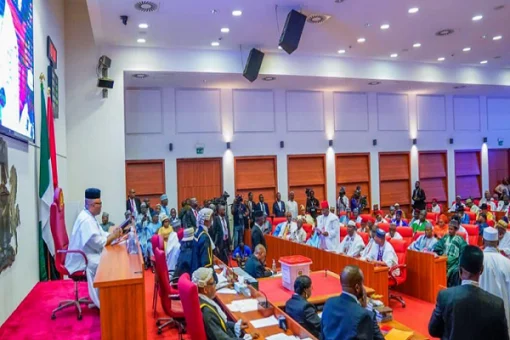
The Senate on Wednesday passed the Electoral Act (Amendment) Bill, 2026, following hours of heated debate, rejecting a proposal that sought to mandate the real-time electronic upload of polling unit results while approving wide-ranging changes to Nigeria’s electoral framework.
Central to the controversy was Clause 60 of the bill, which addresses the transmission of election results. Lawmakers voted to retain the provision in the 2022 Electoral Act, allowing results to be transmitted in a manner determined by the Independent National Electoral Commission (INEC), rather than compelling presiding officers to upload results to the INEC Result Viewing (IReV) portal in real time.
Under the retained clause, presiding officers are required, after counting votes at the polling unit, to record the votes scored by each candidate on a form prescribed by INEC. The form must be signed and stamped by the presiding officer and countersigned by candidates or their polling agents where available.
The provision further mandates presiding officers to count and announce results at the polling unit and to transfer the results, including the total number of accredited voters, in a manner prescribed by the commission.
Any presiding officer who wilfully contravenes the section commits an offence and is liable, upon conviction, to a fine not exceeding ₦500,000 or imprisonment for a minimum of six months.
The rejected amendment had proposed that presiding officers be expressly required to electronically transmit results from each polling unit to the IReV portal in real time after the signing of Form EC8A.
Senators who opposed the proposal argued that the term “real time” was vague, impracticable in areas with poor or no network coverage, and could expose the electoral process to avoidable legal disputes.
Chairman of the Senate Committee on Media and Public Affairs, Senator Adeyemi Adaramodu, insisted that the disagreement was more about wording than substance, stressing that the Senate did not remove electronic transmission of results.
“On transmission, we said we are retaining Section 60 as it has always been. Results must be transmitted electronically and made available to the public,” Adaramodu said. “At the same time, the physical forms – Form EC8A and others – will still serve as evidence.
“They will remain evidence. So we now have correlating evidence: electronic transmission and physical documents. We have not removed electronic transmission.”
He warned against what he described as over-legalising the electoral process through ambiguous language.
“When we talk about real time, how do we define real time?” he asked. “In some places, after voting, the network may not be available, and you may need to travel for one or two hours before you can transmit.
“So can you still insist on five minutes? We cannot subject this matter to semantics. What matters is that results reach the electorate electronically for verification,” Adaramodu said.
Addressing claims circulating on social media that the Senate had voted against electronic transmission altogether, Senate President Godswill Akpabio dismissed such reports as false.
“That is not true,” Akpabio said. “What we did was to retain the electronic transmission that existed in the 2022 Act. Retaining that provision means electronic transmission remains part of our law. Under my watch, the Senate has not rejected electronic transmission of election results.”
He added: “Contrary to reports, the Senate has not rejected electronic transmission of results. Electronic transmission has always been part of our laws. We are moving forward, not backwards.”
Beyond the debate on result transmission, the Senate approved major changes to Nigeria’s electoral calendar.
Lawmakers reduced the election notice period from 360 days to 180 days before the expiration of the tenure of the current administration.
Political parties will now submit their lists of candidates not later than 90 days before a general election, while the deadline for nomination of candidates was also cut to 90 days.
On voter accreditation, the Senate formally removed the smart card reader from the electoral framework and replaced it with the Bimodal Voter Accreditation System (BVAS), while retaining the Permanent Voter Card (PVC) as the sole means of voter identification.
A proposal to allow alternative forms of identification, including electronically generated or downloadable voter cards with QR codes, was rejected.
The Senate also reviewed penalties for electoral offences, increasing the fine for unlawful possession of voters’ cards from ₦500,000 to ₦5 million.
However, it rejected a committee proposal seeking to impose a 10-year ban on individuals convicted of vote buying and other electoral offences.
Senator Asuquo Ekpeyong, who led opposition to the proposal, argued that the decade-long ban was excessive.
He was supported by Akpabio and the Deputy Senate President, who favoured stiffer fines and prison terms without a political ban.
Explaining the thinking behind the tougher financial sanctions, Adaramodu said, “When fines are as low as ₦50,000, people can simply dip their hands into their pockets and pay immediately, and that encourages the commission of offences. So we reviewed that approach.”
One of the most far-reaching amendments relates to candidate disqualification and post-election disputes.
Under the new provisions, political parties will no longer be allowed to replace candidates disqualified after an election.
Where a candidate returned as elected is found not to have scored the majority of valid votes, a rerun election will be conducted, excluding both the disqualified candidate and the sponsoring party.
Adaramodu said the amendment was driven by concerns about fairness and democratic legitimacy.
“There are three key issues here,” he explained. “First is the issue of declaration of winners. Second is candidacy and screening. If a candidate is screened and later disqualified, and the party is told to replace that person, it means the party had control over that illegality. That will drastically reduce pre-election cases.”
He added: “Take a case where a candidate scores 800,000 votes and the runner-up scores 10,000 votes. If the tribunal later disqualifies the candidate with 800,000 votes, do we then allow someone with 10,000 votes to represent the entire community? That person was not elected.
“What we now propose is a rerun election, excluding the disqualified candidate and excluding the party that presented that disqualified candidate. That is more equitable.”
Akpabio praised senators for their endurance during the prolonged session, noting that the chamber remained full well beyond normal sitting hours.
“Let me state clearly: there was no deliberate attempt by the Senate to delay the amendment of the Electoral Act,” he said. “Our intention has always been to do this painstakingly, ensuring that the outcome reflects the yearnings and aspirations of Nigerians.”
He announced the constitution of a conference committee to harmonise the Senate’s version of the bill with that earlier passed by the House of Representatives.
The committee will be chaired by Senator Simon Lalong, with Senators Adamu Aliero, Adeniyi Adegbomire, Orji Uzor Kalu, Abba Moro, Asuquo Ekpeyong, Aminu Abbas and Tokunbo Abiru as members.
Akpabio said the committee had been mandated to conclude its work within the month to enable the National Assembly transmit a harmonised bill to the President for assent, as public attention now shifts to the final shape of Nigeria’s electoral framework ahead of future elections.
