

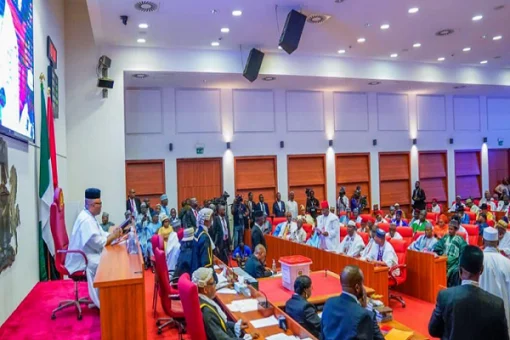
Ahead of the Senate’s emergency plenary scheduled for tomorrow to approve votes and proceedings on the Electoral Act amendment, labour unions, civil society groups and political organisations have intensified pressure on lawmakers over provisions relating to the electronic transmission of election results.
Critics say retaining discretionary language on result transmission weakens safeguards against manipulation and undermines electoral transparency.
They warn that failure to mandate real-time electronic uploads could erode public confidence and compromise the credibility of the 2027 general elections.
Senate President Godswill Akpabio has stepped up consultations with lawmakers amid mounting tensions over alleged manipulation of provisions in the Electoral Act (Amendment) Bill, 2026.
The sitting is expected to determine whether the Senate will formally approve the votes and proceedings from last week’s contentious plenary, a procedural step required before harmonisation with the House of Representatives can begin, and is widely seen as crucial to restoring public confidence in reforms considered central to the credibility of the 2027 general elections.
A statement issued by the Clerk of the Senate, Emmanuel Odo, confirmed that all senators have been directed to reconvene by noon for the emergency session, despite the chamber having earlier adjourned plenary until February 24.
Multiple sources within the National Assembly said the recall became necessary after the Senate adjourned last week without approving its votes and proceedings from the sitting in which the electoral bill was passed.
Without approval, the joint conference committee of both chambers cannot commence harmonising the differences between the Senate and House versions of the legislation. Also pending is the approval of the votes and proceedings relating to the Senate’s delegation to the conference committee.
Ahead of the sitting, principal officers of the Senate and influential committee chairmen are reportedly mobilising lawmakers to ensure a strong turnout and secure approval of the votes and proceedings.
The mobilisation reflects growing anxiety within the leadership over the possibility of dissent, including among members of the ruling All Progressives Congress (APC), which controls about two-thirds of the Senate.
Although the APC enjoys numerical dominance, the controversy surrounding the electronic transmission of election results has reportedly exposed internal divisions, with some senators reportedly dissatisfied that positions discussed earlier during retreats and executive sessions were not reflected in the final outcome of plenary deliberations.
A senior APC senator, who spoke anonymously, suggested the emergency session could be tense, noting that several lawmakers believe the chamber’s will was not accurately reflected in the final decisions announced after plenary.
Fueling the controversy, the Senate minority caucus last week insisted that the chamber had actually passed provisions supporting the electronic transmission of results, contrary to reports that the reform was rejected.
The caucus, led by Senator Eyinnaya Abaribe, accused the leadership of creating confusion around the outcome of the deliberations and called for clarity on the exact provisions adopted.
Abaribe maintained that lawmakers had consistently agreed on electronic transmission of results during committee work, retreats and executive sessions, insisting that the reform was not intended to be discarded.
At the centre of the dispute is Clause 60(3) of the Electoral Act (Amendment) Bill, 2026. During consideration of the legislation, the Senate rejected a proposed amendment that would have made the real-time transmission of results from polling units to the Independent National Electoral Commission (INEC) Result Viewing (IReV) portal compulsory.
Instead, lawmakers adopted the wording contained in the Electoral Act, 2022, which provides that the presiding officer shall transfer election results “in a manner as prescribed by the Commission.”
The decision followed an amendment sponsored by Senator Tahir Monguno that retained the existing clause, effectively removing the requirement for mandatory electronic transmission.
Following widespread reports that the Senate had rejected electronic transmission, Akpabio dismissed the claims as misleading, stating that electronic transmission already exists within the law and that the chamber merely retained the provision previously used in the 2022 elections. However, critics argue that the difference between optional transmission and mandatory real-time electronic upload could weaken safeguards against result manipulation.
