

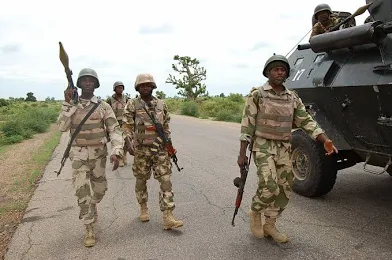
Troops of Nigerian Army’s Operation Whirl Stroke (OPWS) have arrested several suspects, recovered an AK-47 rifle and ammunition, and rescued a kidnapped woman in Nasarawa and Benue states.
The operations, carried out between 24 and 26 March, were part of ongoing pre-wet season offensives aimed at clearing criminal elements from farming communities and major flashpoints in the North-central region.
The Acting Media Information Officer of the Joint Task Force, Ahmad Zubairu, confirmed the developments in separate statements, noting that the operations were based on credible intelligence and targeted at disrupting criminal networks.
“On 26 March 2026, troops of the COAS Intervention Battalion XI under Operation WHIRL STROKE advanced tactically to a suspected terrorist location in the Agasha general area,” Mr Zubairu said. “Upon arrival, the area was swiftly cordoned, leading to the arrest of three suspects.”
He identified the suspects as Sule Ibrahim and Salmanu Risko, both from Nasarawa State, and Abdulkareem Haruna from Jos.
Mr Zubairu said items recovered during the operation included “one AK-47 rifle, two AK-47 magazines, twenty-seven rounds of 7.62mm x 39 ammunition, a Tecno mobile phone, a cutlass, ten sachets of alcohol, and assorted charms.”
He added that the suspects are currently in military custody undergoing preliminary investigation before being handed over for prosecution.
In a related operation on 24 March in Benue State, troops acting on intelligence on armed groups operating in Mbapa and Mbabuande communities of Gwer West Local Government Area conducted clearance operations, leading to the discovery of an abandoned criminal hideout and the arrest of two suspects.
The troops extended the operation across River Akpako, where further exploitation led to additional arrests.
Mr Zubairu said that in another development on the same day, troops responded to reports of kidnapping in Tse-Ubena village in Katsina-Ala Local Government Area.
“During the operation, one kidnapped victim, Mrs Member Ityavber, aged 28, was successfully rescued,” he said. “The victim has been reunited with her family after a debrief, while efforts are ongoing to apprehend members of the criminal syndicate.”
The Force Commander of Operation Whirl Stroke, Moses Gara, commended the troops for their professionalism and resilience, stating that the operations reflect sustained pressure on criminal elements across the joint operations area.
He said the military would continue to dominate vulnerable areas to ensure a secure environment, particularly as rural communities prepare for the farming season.
Operation Whirl Stroke, a multi-agency security outfit operating in Benue, Nasarawa and Taraba states, has in recent months intensified intelligence-driven operations targeting banditry, kidnapping and the proliferation of illegal arms in the region.
Despite these gains, residents in affected communities say security interventions often come after attacks have occurred, urging authorities to adopt more preventive measures.
A resident of Katsina Ala LGA, Mzaga Moses said while the rescue of victims and arrests were commendable, more needed to be done to prevent criminal groups from regrouping.
“We appreciate what the soldiers are doing, but they should not wait until something happens before they act,” he said. “These criminals always return after some time.”
In Nasarawa, Adamu Isa, a community leader in the Agasha axis expressed similar concerns, calling for permanent security presence in vulnerable areas.
What we need is continuous patrol and presence, not occasional operations,” he said. “If the troops leave, the criminals may come back.”
Security analysts also say that while tactical successes such as arrests and rescues are important, they do not on their own dismantle entrenched criminal networks.
They noted that operations like those conducted by Operation Whirl Stroke should be complemented with intelligence coordination, community engagement and improved policing.
The expert also stressed the importance of securing rural areas ahead of the farming season, noting that insecurity in agrarian communities has direct implications for food production and livelihoods.
As the military sustains its offensives, stakeholders say a combination of proactive security deployment, intelligence sharing and community cooperation will be critical in ensuring long-term stability across the North-central region.
